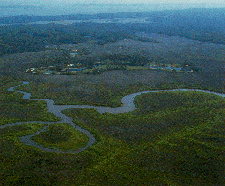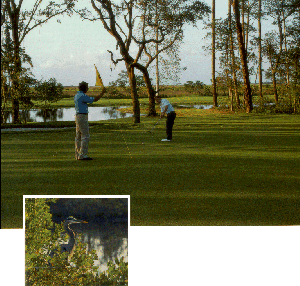
| Recently, as a golfer replaced the
flag on Number 11 and looked out toward the marsh to
Numbers 12 through 15, he remarked to his playing
partners, "I've read and heard so much about these
island holes, I can't believe I'm finally going to
actually play them. And I wonder if they'll be as good as
they said they'd be." Later in the Clubhouse, he was heard to remark, "They're better!" As golfers stand on the elevated green at Number 11, the anticipation does indeed build for the next four holes. It begins as carts roll up onto the elevated cartbridges that network the islands and stretch out over river and marsh to the Par 3, Number 12. The hole's length (110 yards/White) is deceptive. And there's little between tee and green but marsh, water and fickle island breezes. |
Like the golfer who judged the course's island holes to be even better than he expected, architect Joe Lee and the developers of The Hampton Club are delighted with the mix of pleasure and challenge that the completed course now provides to the golfers who play it. |
The blue tees at Number 13 require a
moderate-length carry over an expanse of marsh (most
golfers are choosing the back tees for the added
excitement and challenge). Number 14 is a long, S-shaped
par 5 that counts marsh, lakes and narrow fairways among
its hazards. A huge magnolia tree (at one point, the
entire fairway was reshaped to save it) guards the green.
The beautiful Par 3 Number 15 completes the golfers'
island adventures. The other
mainland holes that comprise The Hampton Club back-nine
are equally beautiful and challenging. Number 10 requires
golfers to carry a portion of Butler Lake while Number 16
begins and ends with lateral water hazards. And the Par 5
Number 18, the course's longest hole, confronts golfers
with a lagoon and yet another towering magnolia tree near
the green. |

 Return to Home Page